Information on this page is for customers in
{{ town-name }}
Natural Gas Pipeline Inspections and Maintenance
We're always working to keep you safe
Proactively Monitoring for Leaks
Our comprehensive maintenance and inspection program, as well as an effective leak management program, exceeds the requirements of federal and state pipeline safety regulations.
Our leak survey program includes:
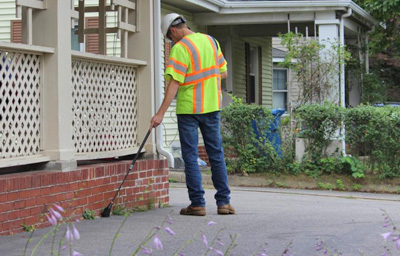
- Semi-annual Surveys – High-pressure distribution lines and critical infrastructure pipes are surveyed for leaks twice a year. High-pressure lines are also patrolled an additional two times.
- Annual Surveys – In business districts, we conduct annual leak surveys over all gas distribution mains. Surveys are conducted from vehicles or on foot.
- Winter Survey – When cold weather and frost are prevalent, we survey all cast-iron mains on a 10-day cycle. The surveys continue until warmer weather returns.
- Tri-Annual Surveys – Every three years, we survey pipelines exposed to the atmosphere, including company-owned piping inside buildings. We meet or exceed state or federal regulations, which require surveys every three years on some types of pipelines and every five years on others.
Meter Inspections and Exchanges
We are required by law to routinely perform safety inspections on gas meters and piping leading up to the meter. These inspections are performed on equipment located inside or outside a home or business to make sure there is no corrosion that could cause a leak or faulty connection over time.
We also exchange your gas meter every seven years because, like all mechanical items, natural gas meters experience wear and tear and may stop performing as intended and can cause billing errors.
Inside Pipe Inspections
Inside Pipe Inspections are for natural gas meters located inside a home or business or inaccessible to our technicians. This inspection is required by federal and state law and is designed to detect potential gas leaks and identify any active corrosion that can potentially weaken the integrity of the gas pipes on your property.
Pressure Monitoring and Protection
Pressure on the gas distribution system is monitored and maintained by specialized equipment positioned in strategic locations throughout the distribution system.
At each location, additional over-pressure protection equipment monitors and limits pressure so gas is delivered to you at the level your equipment is designed to operate. We also monitor system pressures 24/7 at our natural gas control center.
The heart of our gas system is our newly consolidated Gas Control Center. Teams of highly trained and qualified gas controllers monitor and control the flow of natural gas 24 hours-a-day, 365 days of the year using advanced programs.
Pipeline Integrity Management Plan
We are committed to continually improving the safety and reliability of our natural gas pipelines.
In conformance with federally mandated regulations issued by the U.S. Department of Transportation's Pipeline Hazardous Materials Safety Administration, Eversource has implemented a Transmission Integrity Management Program for our transmission pipelines. A Transmission Integrity Management Program is a comprehensive, systematic process for evaluating and reducing risks to pipeline safety.
Identification and risk assessment of threats to pipeline safety
Construction records, operating history, maintenance records, and environmental data are integrated and evaluated to identify conditions or hazards that could negatively impact the integrity of pipelines and to understand the severity of the risk posed by the threat. Risk assessment is an analytical consideration of the risk factors that promotes an effective allocation of resources for appropriate prevention, detection, and mitigation activities.
Identification of high consequence areas
High Consequence Areas are locations with high population density, difficult to evacuate facilities such as hospitals and schools, and locations where people congregate such as churches, office buildings, and recreational areas. Transmission pipelines that are near these locations are prioritized for enhanced pipeline inspections. Eversource consults with public officials in identifying these locations.
Prevention, detection, and mitigation activities
Periodic field inspection of transmission pipelines are conducted within regular intervals to proactively discover locations where the pipeline could be corroding or damaged. Pipeline flaws that are discovered are repaired before they can impact the safety and reliability of the pipeline.
Prevention and mitigation activities are selected to address the unique conditions impacting each pipeline.
Examples of these activities include:
- Patrolling/surveying the pipeline corridor to look for indications of abnormal conditions such as missing pipeline markers, construction activity, potential gas leaks, right of way encroachments, changes to the terrain due to rain/flooding, or other issues detrimental to the safe operation of the pipeline
- Monitoring excavating activity of third parties in the vicinity of our transmission pipelines
- Developing improvements to emergency response
- Communication of pipeline safety information to public officials, emergency responders, the general public, and employees
- Replacement of aging pipeline facilities with state-of-the-art facilities
Continuous safety improvement
As the Transmission Integrity Management matures, our knowledge of the conditions of our pipelines is enhanced. We use this knowledge to continually evaluate the effectiveness of risk reduction activities and our decision making processes. We evaluate the integrity management program for areas of success and looks for other areas on our pipeline system where improvements can be made. Our prevention, detection and mitigation activities evolve to ensure continual improvement in the safety of the transmission pipelines. Eversource actively seeks the use of new technologies and adopts best operating practices to improve the effectiveness of the program.
To view the location of natural gas transmission pipelines operated by Eversource and other companies, visit the U.S. Department of Transportation National Pipeline Mapping System.